Thursday, 15 November 2012

Planning Cinematography

Camera shots are important to include within a thriller film because they help to guide the audience through the film, by demonstrating different aspects of a film's setting, characters and themes. The camera shots are very important in shaping the meaning of the film. 

4 Different Camera Shots;

Close up- A close up shot contains only one characters face and only a fairly small part of the scene fills the screen. The use of this camera shot allows the audience to clearly see the character which  helps them to feel empathy for the character. In our thriller, we will use the close up when the protagonist is searching the forest to make sure she is safe from the antagonist. We chose to use this shot at this time in the narrative because we feel it will be important to show the characters emotions at this point, to let the audience know that she is scared and in danger. This shot will help make our thriller conventional because it allows the audience to build a relationship with the character, as they are able to clearly see her emotions, which will cause the audience to feel a closer bond with the character. They will also feel sympathy and empathy towards her, which is something the audience would expect to see from a thriller and it will help the audience to feel more engaged in the thriller.


Mid-Shot- A Mid-Shot shows the character from the waist up, with a little bit of background. This shot helps the audience to see the characters face more clearly and shows their interactions with other characters. We will use the mid-shot when our character is in the room and the male character walks in. We chose to use this shot at this point in the narrative to show her location and the situation she is in, for example, she is tied to a chair in an empty room. This is because this shot will show everything of importance in the room, whilst still giving the audience an indication of the females emotions. Being able to see the location and emotions all in the same shot is conventional to a thriller film because it helps the audience to understand the situation the character is in which helps them build the relationship with her, causing them to feel more engaged in the film, which is what the audience expects to feel when they watch a thriller film. An indication of the location, but not revealing the whole location is conventional to thrillers because it gives the audience and indication of where the character is and what sort of danger they may be facing, but there is also the enigma of the audience not knowing exactly where the character is, which draws the audience in and makes them feel engaged in the film.


Long-Shot- A long-shot shows the landscape, therefore giving the audience a more specific idea of the setting. There may or may not be a character within this shot. In our film, the long shot will be used when our protagonist is running through the forest, away from the antagonist. We chose to use this shot because it will show the audience exactly where she is, and how isolated she is. This shot gets across our theme of isolation, which will help to make our thriller more conventional of typical thriller films, due to the fact that she is alone and running away. This will show the audience will know that she is in a lot of danger and the fact that there is no one around to help her will build the suspense and tension. 


Deep-Focus- Deep-focus uses the photography technique of depth of field. Depth of field is the technique that shows one thing in the shot in focus, and the rest out of focus. This is used to portray the importance/significance of the character/object in focus. In our thriller, the deep-focus shot will be used when the male and female are both in the room. We will have the villain and the knife in focus to portray his importance in the narrative. This is conventional because it shows how important the villain is. The use of the knife also gives the antagonist power. Having the antagonist and weapon in focus and the background slightly out of focus and everything behind him partially concealed which creates tension and mystery and suspense, elements which are very conventional to thrillers as they are elements that the the audience expect to see as they draw the audience in and engage then further in the film.

Wednesday, 14 November 2012

Individual Storyboard


When I was deciding on what I wanted my storyboard to include, I had to think about things that I hadn't though through before, such as lighting and camera shot. I had to go through my own narratiove andd decide which camera shots would be most efective, which lighting should go where, exactly what iconography I was going to use in each frame.
My idea's are very conventional to that of a thriller film because my location is a dark, empty forest. I chose this because a forest is a place where soemone could commit a crime and have a very good chance  of getting away with it, at least at first. Dark, lonely places like this are very conventional to  thriller because it makes the thriller more suspenseful as a dark, empty place could he hiding any number  of dangers.
Another convetion is the dark, abandoned room and this is covnetional because the chracter appears lonely and vulnerable inside the room and it also leads to an enigma as teh audience wonder how she got there and why she's there.
Weak, female victims and stronger, male antagonists are also a convetion of thriller films because men are typically stronger than females and the audience instantly feels sympathy for the vulnerable female character which leads them to fear the antagonist even more as they worry about the fate of the victim.
I also chose to use low key lighting because most thriller films are set at night in darkness, which creates mystery and fear and suspense. As this is a convetion of thriller films, inculding this is my thriller will makek my own more successful.
The iconogrpahy I chose is also very convetnional as most of the iconogrpahy is weapons, things that can cause pain and tormet to the victim, something that again is very commonly seen in thriller films. The use of the iconogrpahy used in the opening scene will cereate fear and suspense from the audience which is soemthing that the audience would expect to see in a thriller.
Me and my group shared each of our individual storyboards with the group. We looked at each others and discussed which elements we liked the most and used this information to start to put together ideas for our group storyboard.

Monday, 12 November 2012

Character Representation

It is important to have a variety of characters and various representations within a thriller film because having different characters helps the audience to identity with at least one of the characters. It also helps to clearly show which character is the villain and which is the victim; both are characters that are conventional to thriller films. Representation of characters is also very important because, again, it helps the audience to identify with the characters, for example, a young female character, wearing white/light coloured clothes, causes the audience to instantly feel sympathy for her, and an older, strong male villain dressed in dark clothing instantly makes the audience fear the character and they straight away know that this character is the antagonist. My thriller film will have two characters, the villain and victim. 

The victim;
Name- Rowan
Age- 15
Gender- Female
Race- White
Background- Belongs to a middle class family, completely innocent. 
Purpose to the Narrative- She is the most recent victim of the antagonist and gets kidnapped, tied up and held prisoner in an abandoned house in the woods. This does not happen for any reason other than purely because she fits into the criteria of his obsession. As a female victim is incredibly conventional to a thriller, her character is very important to the narrative, as without her, the audience would not feel involved in the film as there would be no character they could connect with and feel sympathy and fear for. 
How will the Character Appeal to the Audience- She will appeal to the audience because she is young and innocent, and many people will be able to relate to her and feel sympathy for her. She also fits the conventions of a thriller because she is a weak female victim who has been overpowered by a man and the audience will expect to see this. 

The Villain;
Name- Reggie
Age- 30
Gender- Male
Race- White
Background- He spent most of his childhood in foster care, but his foster parents changed frequently, which left him feeling abandoned. He now has an obsession with young teenagers and chooses victims that look like each of his foster mothers as he feels that by torturing and killing girls who look similar, he is finally getting revenge on his 'mothers' for abandoning him as a child, something he was never able to forgive them for. 
Purpose to the Narrative- As he a male villain, his character is very conventional to thrillers, so is very important. This is because, without him, the film wouldn't be scary and there would be no suspense or fear, as the audience would have no one to fear and there would be very little enigma.
How will the Character Appeal to the Audience- He will appeal to the audience because he is a complex character with deep rooted issues. As he has already done things like this before, it helps build the fear the audience will feel towards him and this is all conventional to a thriller.

Thursday, 8 November 2012

Production Roles

Different Types of Roles Within Film Production 

It is very important for everyone within with film production to have their own role because that way, the production runs smoothy and successfully. Each role is important because they are all things that are essential to films, such as director and location manager. 

Roles;

Camera Operator- It is the Camera Operators job to support the director and director of photography. They do this by carrying out instructions given to them regarding camera shots and development. Another responsibility of a camera operator is to make sure the camera movements are smooth and seamless.


Actors- Actors and actresses play a very important role within the film because without them, the film would not be successful. It's he actors job to be convincing and play the role the exact way the director wants them to, in order to make sure the film turns out the way it was planned. 


Sound Technician- It is the Sound Technicians job to assemble and operate the equipment which is used to record or reproduce sound. 


Editors- Editors are responsible for turning raw film material into a finished product which is suitable for broadcasting. They work with raw camera footage, dialogue, sound effects, special effects, and graphics. 


Film Director- The Film Director is responsible for the creative vision and overall style of the whole film. The director is also supported by lots of Assistant Directors who ensure the Directors ambitions are achieved. 
Location Manager- The main role of the Location Manager is to find ideal locations for the shoot. They also have to negotiate the the owners of the chosen location about issues such as cost and sound reduction and they have to make sure every location os handed back to the owner in satisfactory condition. 


Storyboard Organiser- The person is responsible for organising the storyboard. This is also important because it determines the plot behind each scene and lets everyone know what the aim of achievements is. 


Our Own Roles;

We then decided on our own roles for our film. 
I will be location manager. This is an important role as the location is a very important element in the film. I feel that I will do well in this role as I am good at making final decisions. I will also be storyboard organiser as when we looked at each other's storyboards and decided on which to use, mine was the main one the group chose.

Sumbal is the director because she is very organised and will be able to do the tasks very well. She will decide on which footage to use and put forward. Another role Sumbal will have is Sound technician, she will be in charge of choosing the sound that we will use in our thriller. 

Drew will be Camera Operator and set designer. This is a good role for him to be in because he has experience with camera's. He will be in charge of mise-en-scene and iconography.

We will all take on the role of editor as we feel that all our ideas are important and so we should all have an input in how the thriller is edited and consequently, how the final cut of our thriller looks. 

Wednesday, 7 November 2012

Pie Charts

I put the results of my questionnaire into pie charts. I decided to use pie charts to present my findings it shows the results in a visual way, which make them quicker and easier to analyse. I will use these results to help me to plan my narrative. I will look at the results of the pie charts and assess which options for the questionnaire were the most popular. I will then base my ideas for narrative around these results, in order to make sure the target audience enjoys my thriller and that my thriller is successful.
These are the pie charts presenting my findings:


Individual Narrative


My Own Idea For a Narrative 

My film would be the beginning sequence of the thriller film. 
It would start in a dark, dirty room, with nothing in it but a chair, which a young female would be tied to. The windows would be boarded up and there would be one dim lamp near her, so the audience could see the character, but not too clearly. The floorboards would be dark, stained wood.  It would be instantly apparent to the audience that the character is in danger as she would be crying and her mouth would be tied up. She'd also have a trickle of blood running down her cheek from her forehead. 
A man would then walk in, but his identity would be kept hidden and he's be carrying a knife. She would keep quiet and look away from him as she doesn't want to know what he's about to do.  I picked an empty, seemingly abandoned room because it is conventional to a thriller film, because it created an enigma, suspense and tension and these are all things that would be good to include in my own thriller because it is all things the target audience would expect to see. This idea is conventional to thriller films because it instantly includes a weak, vulnerable female victim who has been captured which is another feature that will build suspense. 

Another convention that my own thriller includes is the villain being a man, as men are usually the antagonists in thriller films because they are usually stronger and more powerful than women. His identity is also hidden in the film, which again is another convention as it builds fear, anxiety and suspense. Another convention of a thriller film is weapons and blood and I chose to incorporate both these elements into my thriller because, again, they build fear and suspense which engages and captures the interest of the audience. 
The character's will be represented in a very conventional and obvious way; weak, overpowered female victim under the control of a powerful male villain. The target audience will be able to develop a relationship  with the characters because the victim will be young, like the target audience, so they will instantly feel a connection with her. Then when they realise that she is being help captive, against her will, they will start to sympathise with her and fear for what would happen to her. Also, the hidden identity of the villain will evoke fear from the audience, which is another thing that will build the suspense of the film. 

The rest of the feature film would include this character's life in this house, she'd never be allowed to leave. The man would be convinced that she is his wife, and she would be forced to act as such and would be locked in the empty room and punished when she disobeyed him. She'd also be put locked in the room when he leaves the house, to prevent her from escaping. The film would end with a fight between the male and female, and the audience would knot know whether he killed her or not. 


My inspiration for the setting came from Saw 1, because in the beginning of that film, they were in an abandoned, dirty room and people were chained up. I thought of this, then decided to adapt it slightly. Every thriller film I have watched has a lot of low-key lighting, so that's where I got the inspiration to use only one light in the room in the opening sequence. The lack of lighting in the opening of this film creates an enigma and suspense, which would be a good element to use in my own thriller. 
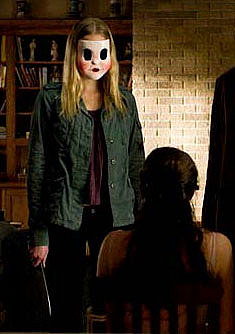
Another inspiration was from the thriller 'The Strangers'. From this, I got the idea of the woman being tied up and the killers holding a knife, then using it to kill both the victims. The knife was threatening and builds suspense as the audience doesn't know if the killer will use it or not. This element of suspense would be a good thing to incorporate into my own film. 
This film also inspired me to use diegetic sound in the opening sequence because the only thing the audience would be able to hear would be the ones hat belong in the film world. This would create suspense because the scene would be almost silent. The use of only natural sound would help the audience to feel more engaged in the film. 

Saturday, 3 November 2012

The History of Thriller Film's


File:Dore ridinghood.jpg
The thriller genre first came about in the form of poems and literature. Ancient 'Epic Poems' such as 'Homer's Odyssey' and 'Epic Of Gilgamesh' use similar narrative techniques as modern thrillers. Another example of thriller in ancient literature is 'Little Red Riding Hood' in 1697, which uses conventions such as a lone, young girl walking through the woods, a villain in the wolf and her grandma being in disguise. These things are very very close to the conventions of modern thriller films.
RiddleOfTheSands.JPG

The first modern thriller is called 'The Riddle of the Sands' and was released in 1903. It was described as '
an open-air adventure thriller about two young men who stumble upon a German armada preparing to invade England'  This was originally a novel, but  has since been made into a film and a TV film. 

Alfred Hitchcock's first thriller was called The Lodger (1926), a suspenseful Jack the Ripper story. His next thriller was Blackmail (1929), his and Britain's first sound film. Of Hitchcock's fifteen major features made between 1925 and 1935, only six were suspense films, such as Murder!, Number Seventeen, The Man Who Knew Too Much, and The 39 Steps. From 1935 on, however, most of his output was thrillers. One of Hitchcock's film's, Rebecca, a psychological thriller, won an Oscar, which is very unusual for a thriller film.
File:Rebecca 1940 film poster.jpg


Hitchcock was not the only director of thriller's during this period. There was also George Cukor, who's thrillers included conventions that are still very common today, such as insanity; weak females; scheming, powerful males; police detectives; serial murderers. 
In the 1950's, bigger film stars began to get involved in thrillers, people such as Marilyn Monroe, Ralph Meeker, James Mason and Grace Kelly. 


File:Psycho (1960 film) shower scene.jpg
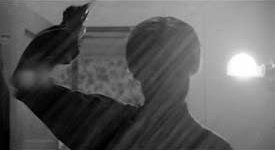
'Psycho' (1960), another of Hitchcock's films was an incredibly famous thriller film, about a loner mother-fixated motel owner and taxidermist. The most famous scene in Psycho is where the shadowy mother figure brandishes a knife towards the camera 


It was in the 1970's and 80's that thrillers started to become violent, with Hitchcock's first British film in almost two decades, 'Frenzy' being rated R for its vicious and explicit strangulation scene. 
Spy, conspiracy and science fiction thriller's were also scattered throughout these decades. 

'Thriller- A Cruel Picture' is on of the first films to be completely banned. The story is about a quiet girl, Frigga/Madeleine, who is sexually assaulted during her childhood, and the trauma makes her mute. When she becomes older, she accepts a ride from a man, Tony, who makes her a heroin addict, and then becomes her pimp. At one point, she is stabbed in the eye for refusing a client. She starts saving up money to buy weapons and take classes in driving, shooting, and martial arts to take revenge. The original running time was 107 minutes. After being banned by the Swedish film censorship board, it was cut down to 104 minutes and then 86 minutes, but still banned. It was finally released after being cut down to 82 minutes. In the United States it had also been cut to 82 minutes.


Through my research, I have concluded that conventions of thrillers have been incredibly important since the beginning of the thriller genre and are still very important today, as the audience would expect to see thins such as insanity or violence or hidden identity. This has helped me to realise that in order for my own thriller to be successful and effective, I need to incorporate as many conventions as possible as the audience would expect to see these conventions. I have also concluded that although my thriller needs to have elements of violence, there cannot be too much violence or any reference to sexual violence, as this would lead to my thriller being banned or those scenes would need to be cut.